
- Blog
- Original
- Philosophy
- Absolutes & Logic
Look at Your Hand. Science Can't Explain the Strangest Thing About It
Every step from the Big Bang to your fingertips has a cause. Every step except one. Wittgenstein noticed it a century ago, and once you see it, it's hard to call anything ordinary again.
"It is not how things are in the world that is mystical, but that it exists."
— Ludwig Wittgenstein, Tractatus Logico-Philosophicus 6.44
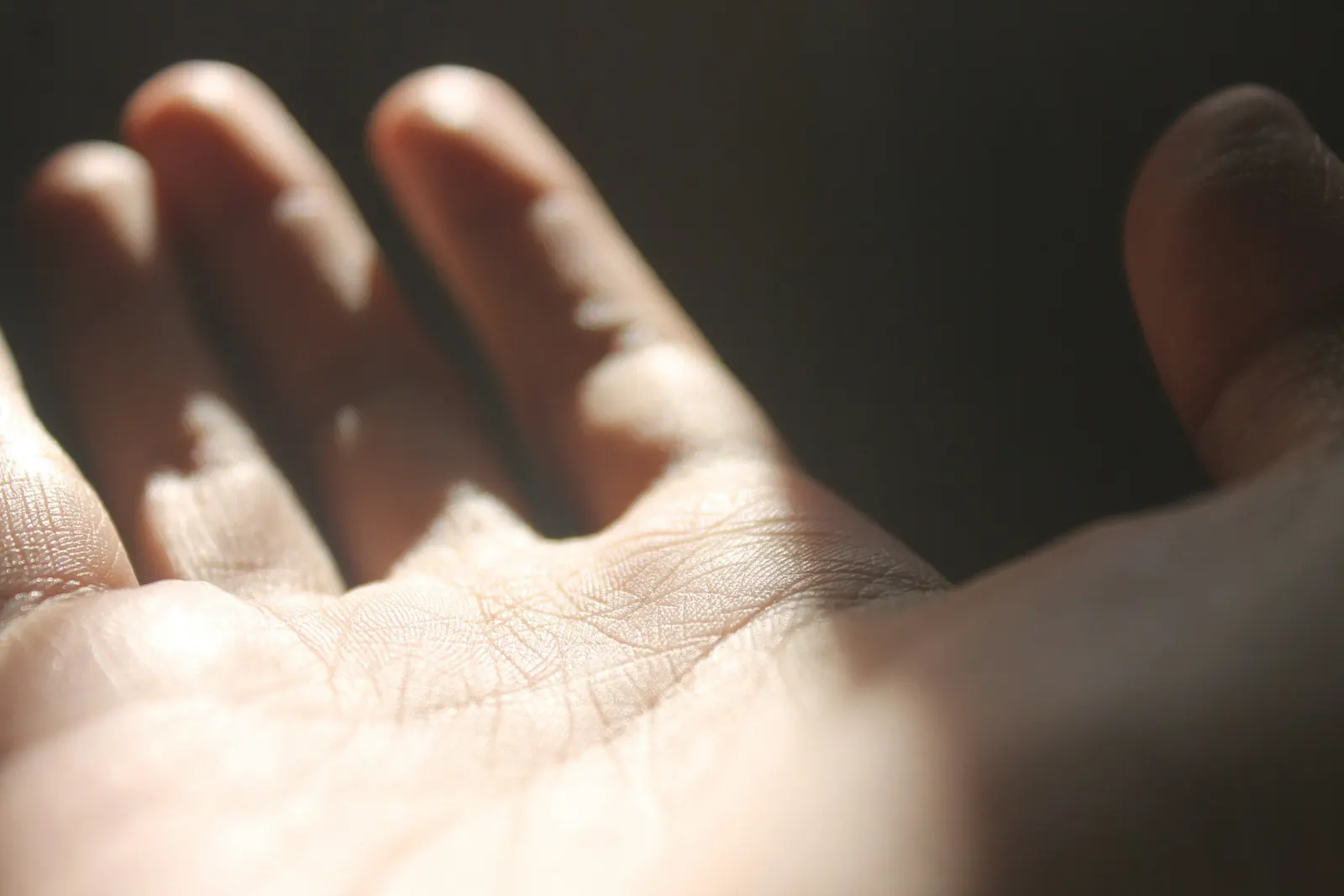
Hold your hand up in front of your face, and keep it there while you read the next few lines.
Look at the creases, the knuckles, the way the fingers move the moment you decide to move them. You have seen this hand thousands of times. It is about as ordinary as anything gets. And yet there is a question about it that science, by its nature, does not answer, and better instruments will not change that.
Science can tell you a great deal about that hand. It can trace it through cells and genes, through evolution and chemistry, back through atoms forged in stars, all the way to the hot, dense early universe. Every step is real. Every step is remarkable. What it cannot tell you is why there is anything there in the first place.
That is the question here: science explains how one thing turns into another, but not why anything exists at all. By the end, I hope your hand looks less ordinary than it did a minute ago. We begin with the chain of causes and where it stops.
The Causal Chain and the One Free Miracle
Ask a scientist why your hand is there and you will get a beautiful answer. Cells built from a genetic code, shaped by hundreds of millions of years of evolution, made from atoms forged in stars, which came from the early universe after the Big Bang roughly 13.8 billion years ago.
But follow the chain to its first link and something odd happens. At the very beginning, the story simply asks you to accept that there was something to start with. Energy, laws, a universe ready to unfold. Terence McKenna used to joke that modern science works on the principle "Give us one free miracle, and we'll explain the rest."
I don't say that to knock science. I love science; it is how I got here. But notice what the causal chain explains: how one thing turns into another. What it never explains is the question Leibniz put in 1714: why is there something rather than nothing? Every explanation presupposes the very existence it would need to explain.
When Every Distinction Collapses
For a long stretch I was absorbed by a single exercise. Take any pair of opposites and ask what grounds both of them.
Self and other. Something and nothing. Subject and object. Finite and infinite. Each time, the pair dissolved into something prior that could hold both poles: awareness, being, experience. Push all the way to the bottom, where something and nothing themselves collapse, and you are left with something undefined. No distinctions. No properties. Nothing you could put into an equation.
That is not a gap in our knowledge. It is what "undefined" means. And here is the turn I did not expect: out of that undefined, here we are. A universe, a body, a hand.
The best word I have found for that is not scientific at all. It is magic, and I mean it without qualification. Not a trick, not a mechanism we haven't worked out yet, but the irreducible fact of something appearing from no-thing. As I put it to myself one night:
"The one true, no bs, no tricks, pure magic trick. The ultimate magician. To fetch and conjure, out of nothing, everything."
It Costs You Nothing
This is what moved the idea from philosophy into something I actually feel.
You did nothing to make your hand appear. You spent no effort, paid no energy, performed no calculation. You look, and there it is, complete, textured, warm, responsive. Every single moment, the entire world shows up for you at no cost.
If a magician did that on a stage, conjuring a living hand from thin air, we would be stunned. Because it happens constantly and everywhere, we have given it a dull name. We call it "reality," as if that settled anything.
That is the main point. "Ordinary" is not a property of things. It is a habit of attention. The magic did not stop. We stopped looking at it.
What the Stuff Is Made Of
There is one more layer, and it is the one that really turned my head around.
Physics tells us the solidity of your hand is a force, electromagnetic repulsion between electron clouds, and its color is a construction of your visual system. Keep zooming in and the stuff dissolves into fields and mathematical description. There is never a moment where you reach the real material underneath.
From the idealist view I have come to, that makes sense. What the hand is made of, the texture you feel when you rub your fingers together, is not a substance hiding behind experience. It is experience. That is what consciousness feels like from the inside: like a hand.
You can disagree with the metaphysics and still feel the force of the point. Whatever your hand ultimately is, its existence is not explained by anything else in the picture. It simply is.
The Meditation I Actually Do
This changed what meditation means to me. I used to think it was about reaching some special state. Now it is mostly this:
"Stopping every once in a while to be utterly stunned and bewildered at the literal magic of my hands, or my dinner fork, or my couch"
That is all. No technique. Just catching the moment of existence before the mind files it under "normal."
It sounds childish. It might be. Children go wide-eyed at things adults stopped noticing decades ago, and I am not sure the adults are the ones who got it right.
Back to the Village
There is an old pattern in hero stories. After the great journey, the hero comes home to the same village, steps into the same river, goes back to chopping wood and carrying water. Nothing has changed, and everything has.
That is how this feels to me. I went all the way down, through physics, philosophy and the hard problem, looking for the bottom of reality. What I found there sent me straight back to my own hand, my fork and my couch, seeing them as if for the first time.
So look again. Your hand is right there. You didn't make it. You can't fully explain it. And it showed up anyway.
What else have you been calling ordinary?
Like and share
Keep Reading
- Blog
- Original
The Burning Bush Said One Word Too Many
It's the shortest word in the language, a single stroke of the pen. An endless regress, Gödel and Exodus 3:14 all circle it, and once you notice what it holds, everything else starts to sound like padding.
- Blog
- Original
Look in a Mirror. Something Is Missing From the Reflection
A camera can't photograph itself. Turn your attention around to catch the one doing the looking, and it has already stepped back. Gödel found the same blind spot inside mathematics.
- Blog
- Original
Mary Knew Everything About Red. Then She Saw It
A scientist who has studied every wavelength and cone cell steps out of a black-and-white room and sees a rose. Philosophers have fought over this for decades. I think they've been fighting about the wrong thing.
Join the discussion
Comments