
- Blog
- Original
- Philosophy
- Absolutes & Logic
The Burning Bush Said One Word Too Many
When God spoke to Moses at the burning bush in Exodus 3:14, the answer was three words that might have been one too many.
It's the shortest word in the language, a single stroke of the pen. An endless regress, Gödel and Exodus 3:14 all circle it, and once you notice what it holds, everything else starts to sound like padding.
Part of Absolutes
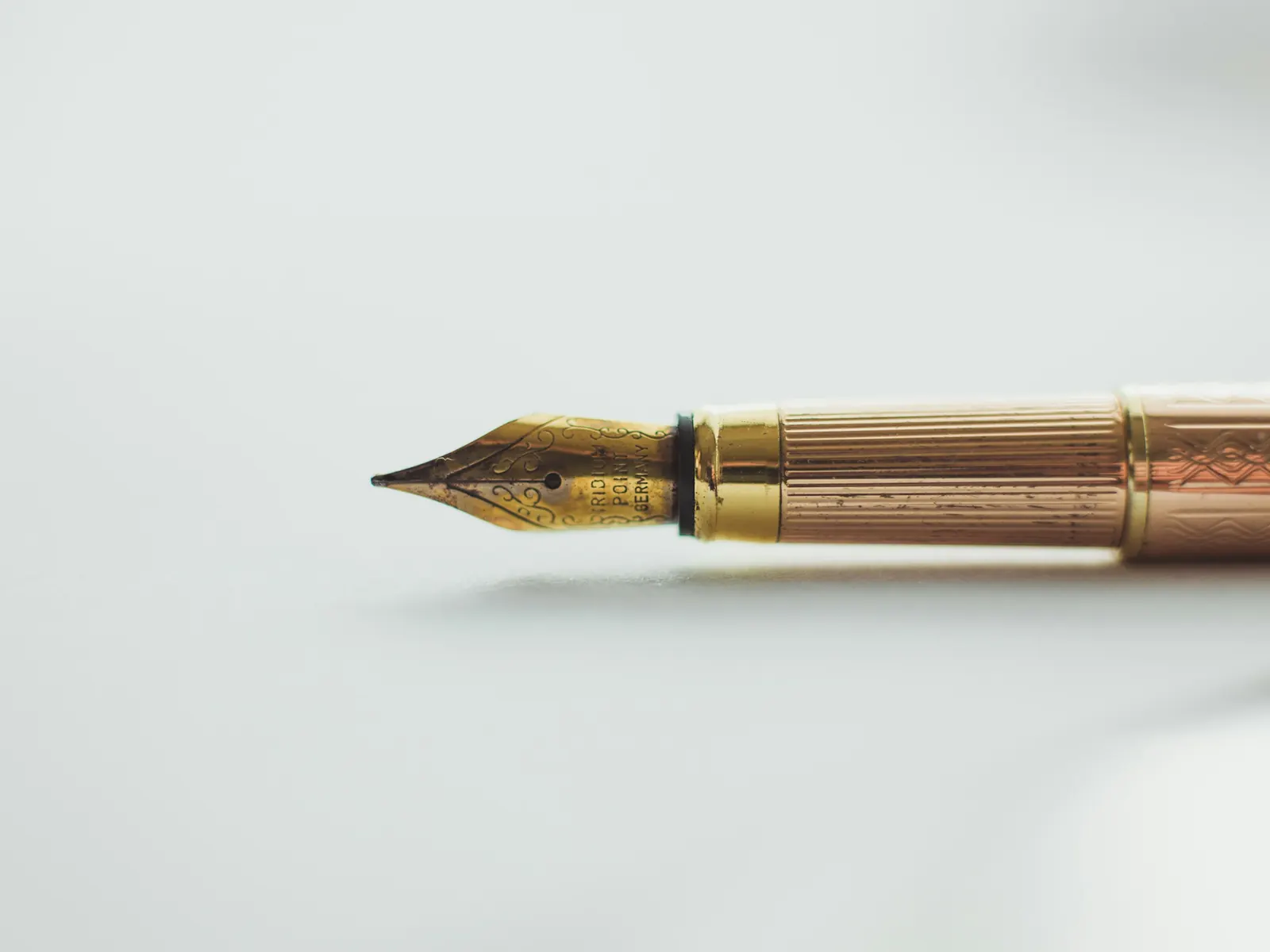
"And God said unto Moses, I AM THAT I AM."
— Exodus 3:14 (KJV)
When Moses asks for a name at the burning bush, the answer he receives is three words long, repeated: I AM THAT I AM. I have come to think even that says more than it needs to.
That sounds like an odd thing for a Christian to say about one of the most famous lines in scripture. But I reached it by an unusual route, through an endless regress, one of the best-known results in twentieth-century mathematics, and a long look at the shortest word in the English language.
It is one letter, one stroke of the pen. I.
We use it hundreds of times a day without a second thought. I'm hungry. I think so. I'll be there at six. For most of my life it never occurred to me that this tiny word might be the deepest thing any of us ever says. I want to follow that word, layer by layer, all the way to the word I think the burning bush could have done without.
The Word That Steps Back
Try something. Notice yourself reading this sentence.
Now notice the one who is noticing. Then notice that.
Every time you step back to observe "I," there is another "I" doing the stepping back. You can never catch it from the front. It is always one step behind, always the one looking, never the thing looked at. That endless regress is usually treated as a bug in our thinking, a sign we have confused ourselves.
I started to see it the other way around. The regress is not a failure to find the self. It is the most accurate description of it we have. What "I" points to cannot be turned into an object, because it is what every object appears to. Step back forever and you never hit a wall. That is what "infinite" feels like from the inside.
Gödel and the Mirror
Around the same time, I had a moment of real excitement, connecting this to one of the most famous results in mathematics.
In 1931, Kurt Gödel proved that any consistent formal system rich enough to do basic arithmetic contains true statements it cannot prove from within itself. Roughly speaking, no such system can fully capture itself on its own terms. Douglas Hofstadter later built a whole book, I Am a Strange Loop (2007), around the idea that the self has a similar self-referential structure.
My own version of the thought was this: perhaps awareness is the thing that can never fully model itself. We can model the brain, scan it, map it. But the one doing the modeling is always outside the model. It is an analogy, not a proof, and I hold it loosely. But it gave shape to something I had felt for a long time: "I" is a strange loop with no bottom.
Why Nothing Is the Only Way to Be Unlimited
This is where it became stranger, and where I think the real power of the word lies.
If "I" can never be pinned down as any particular thing, what is it? It is not the body, the thoughts or the story. Every attempt to define it adds a limit, and whatever "I" is, it is always the one noticing the limit.
"The only way to be unlimited is to be nothing. THATS why reality is and must be nothing."
To be a thing is to have edges: here and not there, this and not that. Something without edges is not a thing at all. That sounds like a loss until you see what it means. What has no edges is not missing anything. It includes everything. Nothing and everything turn out to be the same coin seen from two sides.
That is what I started hearing in the single letter: the whole of infinity and the whole of emptiness, packed into one stroke.
The Burning Bush Said One Word Too Many
Which brings me back to the most famous self-description in scripture.
When Moses asks God for a name, the answer in the King James translation is "I AM THAT I AM." For centuries people have read that as a statement of pure being: God simply is, with no further qualification.
As someone raised Christian, I had always found it beautiful and a little mysterious. Now it struck me as almost exactly right, with one small addition too many. This is how I put it after a long night of thinking:
"…That's why even I Am is too much to say. Suffice to say "I""
The "Am" adds being as a property, something the I has. But the I does not need to have being. It does not need anything added. Every description I had ever read, "pure awareness," "the Self," "I am that," was trying to qualify what cannot be qualified. The truth was simpler than any of them.
Eye and I
One more thing, which I will admit is just a fun coincidence. In English, "I" sounds exactly like "eye," the organ you see with, and the one thing you can never see directly without a mirror.
Linguists will tell you the two words come from completely different roots. Old English ic and ēage simply ended up sounding the same. There is no hidden etymology. Still, I can't help smiling at it. The word for the self and the word for the seeing organ are spoken identically, and both share the same quirk: they look out, never in.
Saying It Differently
None of this requires believing anything unusual. You don't need a new doctrine or a mystical experience to check it. You only need to look for the one who is looking and notice, honestly, that you never find an edge.
Since all this, I hear the word differently. When someone says "I'm tired," I hear two things: the person, with their history and their tiredness, and underneath it the one word that every person in every language uses to point at the same place.
Billions of people, each saying "I," each meaning themselves. Perhaps each pointing, without knowing it, at the very same thing.
Try it now. Say the word quietly, and before your mind adds anything (I'm, I want, I should), stop. When you say only "I" and add nothing after it, is anything actually missing?
Like and share
Keep Reading
- Blog
- Original
Look at Your Hand. Science Can't Explain the Strangest Thing About It
Every step from the Big Bang to your fingertips has a cause. Every step except one. Wittgenstein noticed it a century ago, and once you see it, it's hard to call anything ordinary again.
- Blog
- Original
Look in a Mirror. Something Is Missing From the Reflection
A camera can't photograph itself. Turn your attention around to catch the one doing the looking, and it has already stepped back. Gödel found the same blind spot inside mathematics.
- Blog
- Original
Mary Knew Everything About Red. Then She Saw It
A scientist who has studied every wavelength and cone cell steps out of a black-and-white room and sees a rose. Philosophers have fought over this for decades. I think they've been fighting about the wrong thing.
Join the discussion
Comments