
- Blog
- Original
- Philosophy
- The Observer
Look in a Mirror. Something Is Missing From the Reflection
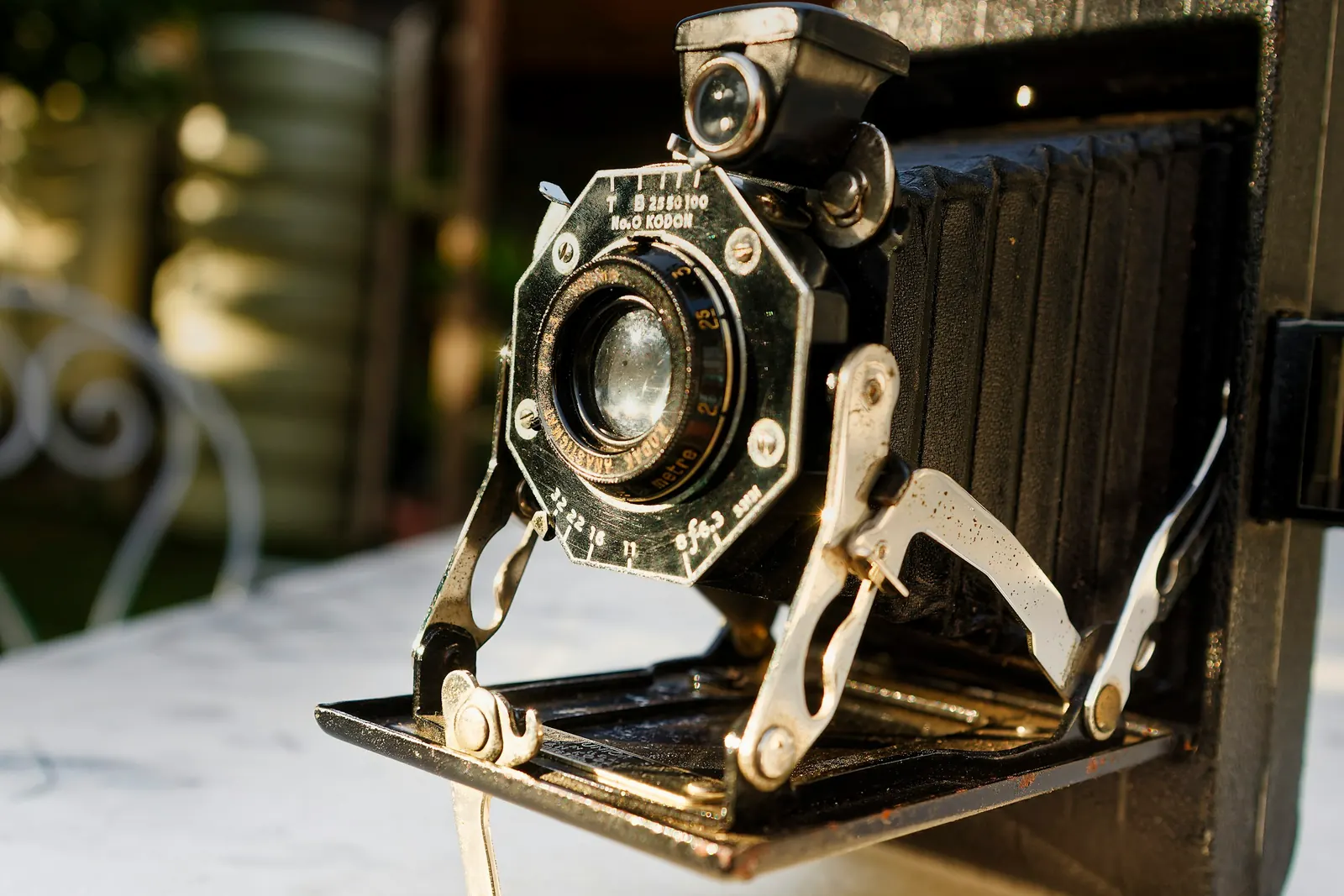
A camera can't photograph itself. Turn your attention around to catch the one doing the looking, and it has already stepped back. Gödel found the same blind spot inside mathematics.
Part of The Observer
"You cannot see the seer of seeing; you cannot hear the hearer of hearing; you cannot think the thinker of thinking; you cannot know the knower of knowing."
— Brihadaranyaka Upanishad (3.4.2)
Stand in front of a mirror and look at yourself for a few seconds.
Everything you would expect is there: a face, a body, a person standing in a room. What the mirror shows is the person being looked at. It never shows the one doing the looking, and most of us never notice that gap.
It took me a long time to see it. When I did, it led through cameras, an ancient Upanishad and one of the most famous results in twentieth-century logic. The question is simple: when you look for the one who is looking, why can you never find it?
Start with what you actually see. A face, a body, a person. An object. It sits in the room the same way the lamp and the window frame do. If you stay with it, something odd happens. You realize this is exactly how everyone else sees you: as an object in their visual field.
I wrote this down the first time it hit me:
"When I stand in front of a mirror, I realize that I'm looking at an object. Then I realize that that is the exact same way the rest of the world sees me."
That leaves a question hanging. If the thing in the mirror is the object, who is looking at it?
The Camera That Can't Photograph Itself
Here is a simple version of the puzzle. Can you point your phone's camera at your phone's camera? You can film the phone in a mirror. You can film another phone. But the lens cannot capture the lens in the act of capturing.
Can the recorder ever be the recorded?
That is not a technical limitation waiting for better engineering. It is built into what it means to observe. Observation has a direction. There is the side doing the looking and the side being looked at, and whatever you point at ends up on the looked-at side, automatically.
The Regress That Never Bottoms Out
This is where it becomes strange. Suppose you try to turn your attention around and look at your own awareness. You try to catch the observer in the act.
The moment you find something to look at, a feeling, a sense of presence, a "me" behind the eyes, it has become an object. It is on the far side of the lens. And whoever is looking at that has quietly stepped back out of view.
So you look for that one. The same thing happens.
Were one to probe, there would still be another probing which is not being probed. And were that to be probed, it would require yet another unprobed one to do the probing. Science meets the same thing from the outside. Even if we turned away from mathematics and tried to probe the substrate of reality directly: who probes the prober?
It is an infinite regress. Usually an infinite regress is a sign that you have made a mistake somewhere. Here, I think, it is a clue.
What Gödel Has to Do With It
In 1931 Kurt Gödel published his incompleteness theorems, which show that any consistent formal system rich enough to do arithmetic contains truths it cannot prove from within itself. The system cannot fully capture itself.
I am not claiming Gödel proved anything about consciousness. But the shape is familiar. Something that tries to model itself completely from the inside runs out of room. And it pushed me toward a thought I keep returning to: the very fact that we can model the brain, put it in a scanner, treat it as an object, suggests that the brain is not the final looker. It is something being looked at. The one doing the modeling keeps escaping the model.
Every Description Is Too Much
I noticed something about the old spiritual phrases. "I am that." "I am." "I am the witness." They all seem to circle the same point without quite landing on it.
I think that is because every description adds something. A label is an object. A concept is an object. The moment you say "the observer is this," you have put it back on the looked-at side.
The ego, interestingly, is exactly what you get when the observer tries to look at itself and grabs whatever appears. It says I, me, my, but those are all objects. They are things the looker sees. When you are actually being the observer rather than looking at it, the narration stops. There is just a kind of silence of seeing.
You can sometimes notice that silence afterwards. But the noticing turns it into an object again. You can point closer and closer. You cannot grab it.
The Unsettling Part
I will be honest about something. Occasionally, with enough clarity, I have glimpsed it. Not as a thing, but as the unmistakable sense that I am that, the looking itself, not the person in the mirror.
Every time it happens it properly unsettles me. Not in a bad way. In a visceral, almost fearful way. It is the feeling of discovering that you were never the character on the screen. You were the light the screen is made of.
Why It Has to Be This Way
So why can't you see the one who is looking?
My best answer is this: because it is not a thing. Things are what appear. The looker is what they appear to. If it could be seen, it would be one more object in the room, and we would have to ask who was seeing it.
The regress is not a failure to find the observer. It is the observer's signature. Wherever you look, it is on this side of the looking. Always one step back. Never absent, never caught.
That changes how I understand "me." I am not the face in the mirror, and I am not the thoughts about the face. I am the awareness that sees both, and that is why I can never see it as an object: it is what is doing the seeing.
The next time you are in front of a mirror, try it. Look at the object looking back. Then ask, quietly, who is seeing it. You won't find an object that answers the question. What you may notice is that the seeing was already here before you asked, and that it is the closest thing to you there is.
Like and share
Keep Reading

- Blog
- Original
Clone Me Atom for Atom. Whose Eyes Do I Wake Up Behind?
The copy walks like me, talks like me and remembers my childhood. I'm certain I wouldn't see through its eyes. That certainty is stranger than it sounds, because my atoms were never fixed in the first place.

- Blog
- Original
Physics Says Nothing Is Ever Truly Erased. Then What Happens to You?
Burn a book and, in principle, every word survives in the smoke. The same rule applies to the information in your brain. Whether that says anything about death depends on a question physics hasn't answered.
- Blog
- Original
Look at Your Hand. Science Can't Explain the Strangest Thing About It
Every step from the Big Bang to your fingertips has a cause. Every step except one. Wittgenstein noticed it a century ago, and once you see it, it's hard to call anything ordinary again.
Join the discussion
Comments