
- Blog
- Original
- Science
- Biology & Evolution
If the Asteroid Had Missed, Who Would Be Reading This?
A city-sized rock cleared the stage for us 66 million years ago. Replay history without it and the candidates get strange: a hunter older than trees, a bird that may already be wondering about us, and a shape evolution keeps reinventing.
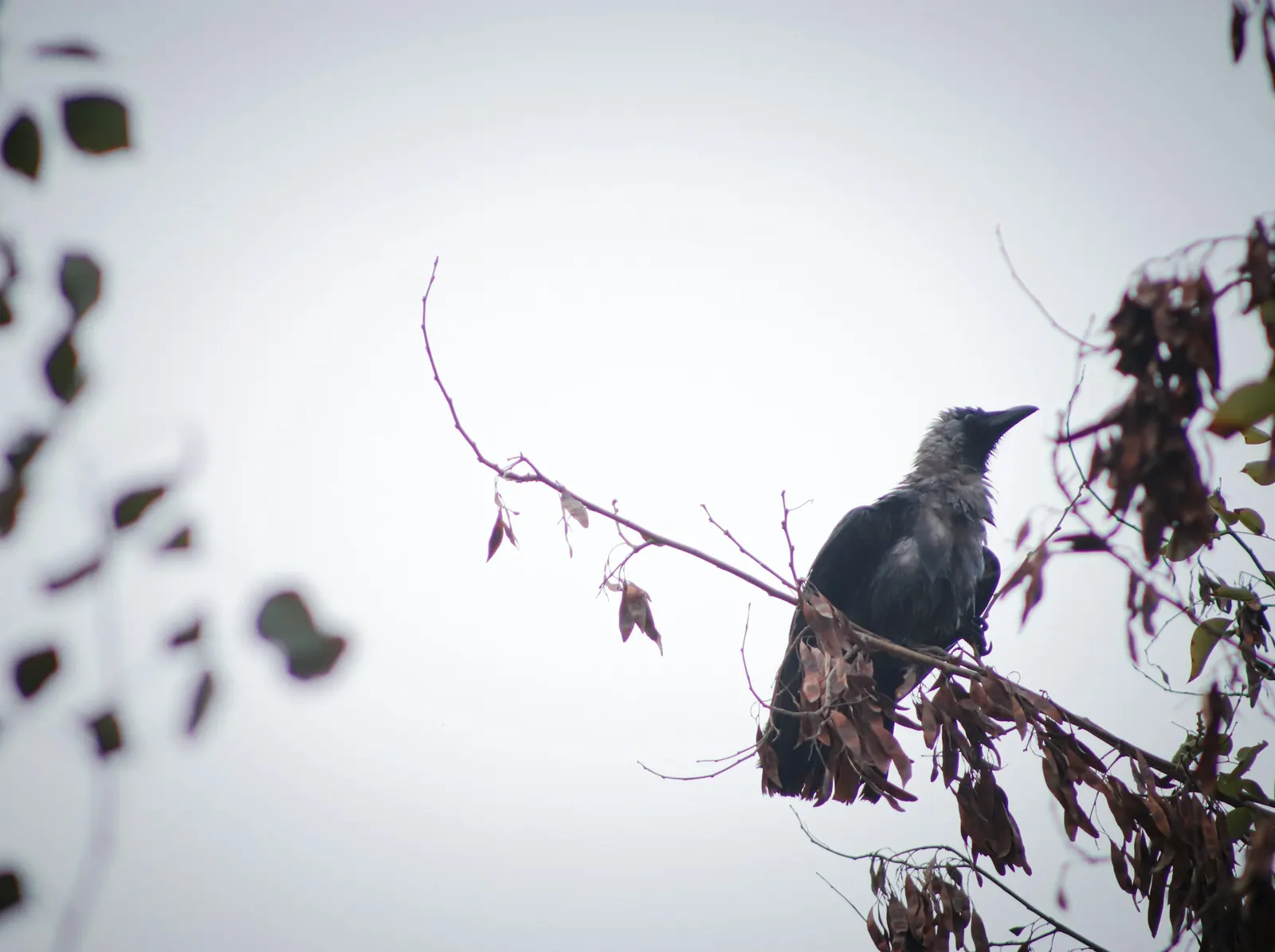
About 66 million years ago, a rock roughly the size of a city struck what is now Mexico's Yucatán Peninsula. If it had missed, you would almost certainly not be here to read this. The more interesting question is who might be reading it instead.
The Chicxulub impact set off a global catastrophe that ended the reign of the non-avian dinosaurs, along with roughly three quarters of the species on Earth. Without it, mammals might have stayed small and scurrying in the shadows. No primates swinging through the trees. No us.
I keep coming back to that. How much of our existence comes down to one very bad afternoon for the dinosaurs? And if you could rerun the history of life, would anything like us show up anyway?
Consider the candidates. First an animal that has been superb for hundreds of millions of years and never needed to think like us, then a bird that may already be studying us, then a body shape that evolution keeps rebuilding from scratch, and finally what all of that suggests about our own kind of mind.
The Sharks Problem
My first thought was about sharks.
Sharks have been around for more than 400 million years. They are older than trees. They have survived several mass extinctions, and they are superb at what they do. But in all that time they never developed anything like technology. They didn't need to. A perfectly adapted predator in a stable niche has no pressure to become a philosopher.
So I asked whether sharks show the asteroid was necessary: whether intelligence like ours needs the board to be wiped clean so that some odd, flexible survivor gets its chance. Life can stay excellent at one thing for hundreds of millions of years without changing direction.
That even made me wonder about the Fermi paradox, the puzzle of why we haven't heard from alien civilizations. Perhaps on many worlds life gets good at surviving and simply stays there, never facing the kind of catastrophe that forces something new.
The Crows Answer
If the asteroid had missed, or if mammals had stumbled, who might have taken our place? Crows come up again and again, and the more I learned, the more I understood why.
Crows and their relatives are astonishingly clever. New Caledonian crows make and use hooked tools. Researchers at the University of Washington showed that crows can recognize individual human faces and remember people who treated them badly, and that they pass that information to other crows who never met the person. Their brains are small, but bird brains pack neurons remarkably densely.
There are also well-documented stories of crows forming relationships with people who feed them, sometimes even leaving small objects behind. That led me to an obvious, slightly unsettling question:
"Are humans domesticating crows or crows are domesticating humans?"
If a crow works out that a particular person reliably brings peanuts, and changes its behavior to keep that person coming back, who is training whom?
Cats raise the same question. They most likely domesticated themselves, moving into early farming villages around 10,000 years ago to hunt the rodents drawn to stored grain. They have negotiated remarkably good terms with us ever since, often giving back little more than their company. It is hard to say we were the ones running that deal.
The Fear of Anthropomorphizing
Scientists are trained to be wary of anthropomorphizing, reading human minds into animal behavior. That caution is healthy. It is easy to fool ourselves.
But it can also become a blindfold. If a crow solves a multi-step puzzle, recognizes faces and seems to manage a relationship with a human, at what point do we admit there is real reasoning going on? There is a deeper problem underneath: we can never directly observe anyone's inner experience, not even other humans'. The line between "behaves as if it thinks" and "really thinks" will never be crossed by measurement alone. At some point we have to decide how to treat other minds without proof.
Crabs Keep Happening
Now for the strangest evolutionary fact I learned along the way.
I once came across a claim that crabs had "gone extinct five times" and kept coming back. That is not quite right, but the truth is better. The crab body plan, a flattened shell with the tail tucked underneath, has evolved independently at least five separate times among crustaceans. Biologists have a word for it: carcinization. Nature keeps rediscovering the crab.
That is a clue to the bigger question. The paleontologist Stephen Jay Gould argued that if you replayed the "tape of life," you would get a completely different outcome every time. Others, such as Simon Conway Morris, have argued the opposite: that evolution converges on good solutions again and again, like eyes, wings and perhaps even intelligence. Crabs are a point for convergence. So are the separately evolved large brains of octopuses, crows and apes.
Built for This Moment
One last thought surprised me.
The non-avian dinosaurs ruled for well over a hundred million years. Our species has been around for roughly 300,000. It is entirely possible they will outlast us by a wide margin in total time on the planet.
But I don't think that means we are a failed design. This is how I put it:
"Isn't it interesting that perhaps our state of consciousness is ideal for whatever the heck we're doing right now."
Our kind of mind, restless, self-aware and endlessly curious, might not be built for longevity. It might be built for this: questioning, building, and looking back across 66 million years to wonder why we are here at all.
The Crow on the Wire
If there is a lesson here, it is humility. Intelligence is not a ladder with us at the top. It is a branching bush, full of accidents and repeats, and other branches might have grown just as tall if events had gone differently.
So the next time a crow on a wire tilts its head and watches you, consider this: if the asteroid had missed, do you think it would be a crow, an octopus, or something we have never imagined that ended up asking these questions?
Like and share
Keep Reading

- Blog
- Original
Stars Build Order. So Do Hurricanes. Why Aren't They Alive?
Leave a rock on your desk for a year and it never changes. Cut your finger and something in you starts repairing it within minutes. In 1944 Schrödinger said life feeds on something strange, and the real difference isn't what most people guess.
- Blog
- Original
I Doubted Everything. One Thing Refused to Leave
I came to this through equations, not incense. Somewhere between Plato and Bohr I hit a wall that our best physics still quietly steps around, and it would not move.
- Blog
- Original
You Have Never Touched Anything. Not Once
Press your hand flat on a table. It feels as solid as anything gets. Zoom in and the solidity turns into something else, and then that something else starts to disappear too.
Join the discussion
Comments