
- Blog
- Original
- Science
- Quantum & Reality
You Have Never Touched Anything. Not Once
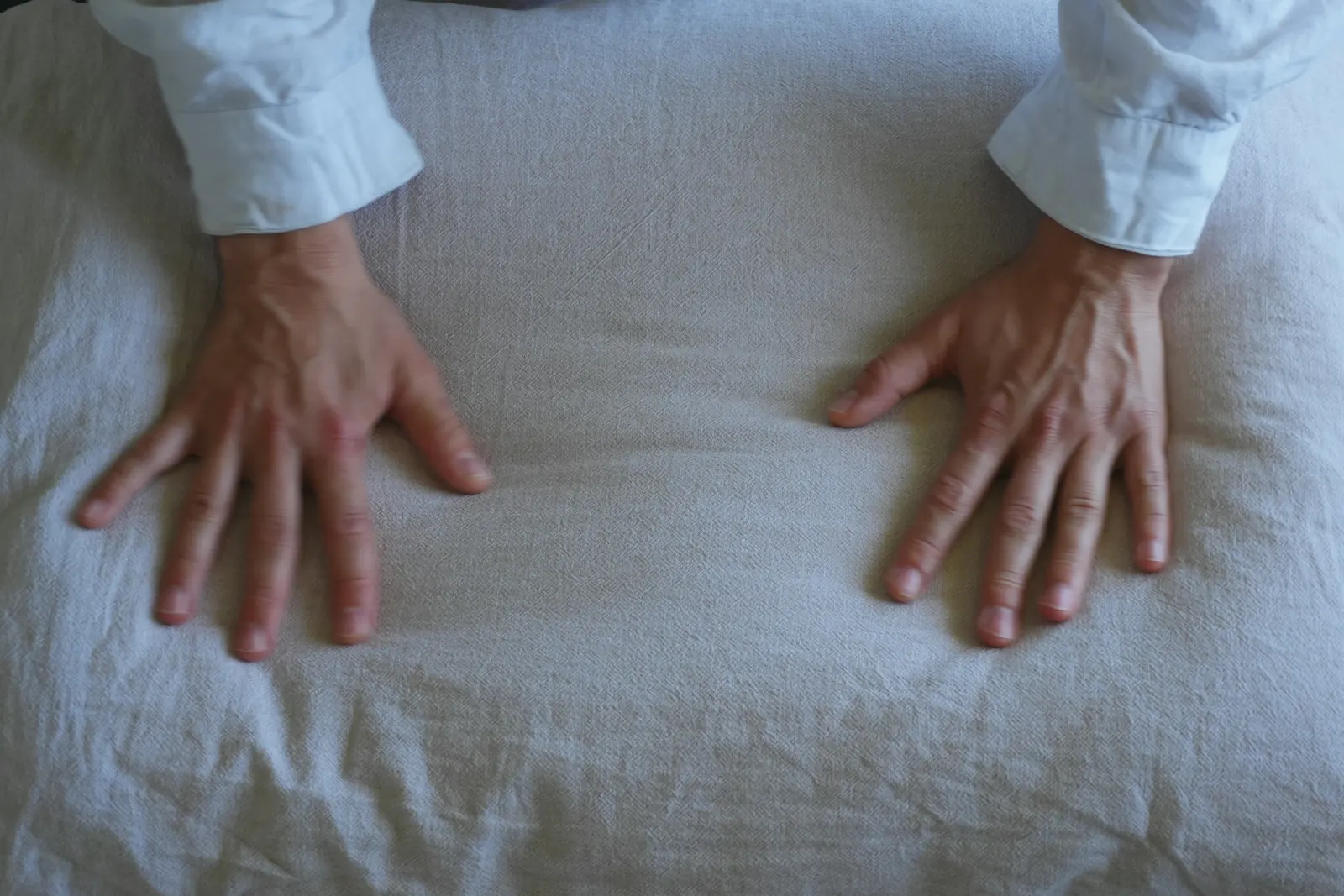
Press your hand flat on a table. It feels as solid as anything gets. Zoom in and the solidity turns into something else, and then that something else starts to disappear too.
"The atoms or elementary particles themselves are not real; they form a world of potentialities or possibilities rather than one of things or facts."
— Werner Heisenberg, Physics and Philosophy
Press your palm flat on the nearest table and hold it there for a moment.
That pressure is probably the most trusted sensation you have. Something hard meets something hard, and there is nothing to interpret. If any experience counts as direct contact with the world, it is this one.
Physics describes it differently. In the ordinary sense of the word, your hand has never touched the table.
Every atom in your skin and in the wood is wrapped in a cloud of electrons. As the two surfaces approach, those clouds push against each other through electromagnetic repulsion, and the Pauli exclusion principle forbids their electrons from crowding into the same quantum states. The result is a resistance that climbs steeply as the distance shrinks. The nuclei in your fingertip and the nuclei in the table stay a few tenths of a nanometre apart, roughly the width of an atom. What you feel as hardness is that resistance. It is a force, not a substance.
When I first read that, I kept coming back to it. And the further I followed it, the further the question went.
If touch is a force, then sound is a pressure wave, and color is a band of wavelengths with no redness in it anywhere. Each time I went looking for the stuff underneath, it moved one layer down. Wood became cells, cells became molecules, molecules became atoms, and atoms became excitations of quantum fields, described entirely by mathematics.
By the end of this, the table will still be there, and your hand will still stop when it meets it. But it may be much harder to say what either of them is made of. The question is simple: if every layer of matter turns out to be a description of behavior, what is the feeling of hardness, and what is doing the feeling?
The first step is to look more closely at the push itself.
The Push That Holds Everything Up
The popular version goes like this: atoms are mostly empty space, and the only reason your hand doesn't pass through a wall is the forces between particles. Forces are not things. They are properties, descriptions of how things behave. Remove the repulsion and, in this picture, your hand would slide through everything.
Physicists will add some nuance, and they are right to. "Empty" is a cartoon. Electrons are not tiny balls orbiting far from the nucleus. They are smeared out as probability clouds that fill the atom. But the nuance makes the picture stranger, not more comfortable. What fills the atom is not stuff. It is a mathematical description of where interactions are likely to happen.
So the natural next question is why some touch feels soft and some feels hard. There is a perfectly good physical answer, about how materials deform and how forces spread through them. But underneath it sits the question I actually cared about.
Why should a force feel like anything at all?
Every Sense Tells the Same Story
Once you notice this with touch, you start to see it everywhere.
Sound is pressure waves moving through air. The sound itself, the experienced quality, is not in the air. It shows up only in a hearing creature. Color is a range of electromagnetic wavelengths, and there is no redness anywhere in the equations that describe light. Taste and smell are molecules fitting receptors. The flavor of coffee is not a property of a molecule floating in a cup.
One day I wrote it out bluntly to myself:
"Think of it, touch is em force, sound is air waves, eyesight and color is fully in the mind. What is actually out there really? Is there even anything??????"
That was not a rhetorical flourish. It is where the physics points if you take it at face value. Everything you have ever directly known about the world, every texture, tone, color and taste, lives on the experience side of the line. What sits on the other side is described entirely by mathematics.
Peeling Back the Layers
So I tried to look at the other side directly. What is matter, apart from how it behaves?
Zoom in on the table. Wood, then cells, then molecules, then atoms. Atoms are nuclei and electrons. Electrons are excitations of a quantum field. And a field is a mathematical object that assigns values to every point in space and tells you how those values change.
At no step do you reach a small lump of stuff that simply sits there being solid. You reach descriptions. Relationships. Probabilities of interaction.
"When you peel back the physics, I just don't see anything there besides pure numbers and descriptions."
I once imagined bringing one of the greatest living theoretical physicists into a room and asking him to tell me what matter actually consists of, apart from the equations. That is not meant as an insult to him. I genuinely don't think anyone can answer, because physics was never designed to say what things are. It tells us, with extraordinary precision, what things do.
The Founders Saw It Too
This is not a fringe idea I invented. The founders of quantum mechanics wrestled with it openly. Heisenberg described elementary particles not as things or facts but as potentialities. Read plainly, quantum theory does not describe a world of tiny solid objects. It describes possibilities that become definite when they interact.
What still astonishes me is how casually we live on top of this. We say "the physical world" as though we know what physical means. Chase it all the way down and matter turns out to be abstract. Whatever reality is at bottom, it looks much more like information, or like experience, than like the hard lumps we picture when we press a palm against a table.
The Part Physics Leaves Out
This is where I have landed, at least for now.
When you touch the table, two things are happening. On one side there is a lawful pattern of interactions, which physics describes with stunning precision. On the other there is the felt hardness, the only part you have ever actually encountered. Physics gives us the first. It is silent about the second.
The usual assumption is that the felt side is decoration the brain paints over the real, physical side. But look at what we actually know. We have never touched the physical side directly. Every piece of evidence we have for it arrives through experience. The mathematics is a map we infer. The hardness is given.
That thought started my long road from physics to somewhere much stranger. Not a rejection of science, but science followed honestly to the place where it stops saying "this is what it is made of" and starts saying "this is how it behaves."
A Small Experiment
The next time you rest your hand on something solid, pause for a second.
Feel the hardness. Then remember what it is according to physics: a field pushing back, held in place by quantum rules, made of nothing that would look like stuff if you could zoom in far enough.
And then ask the question physics leaves unanswered: what is doing the feeling? Physics can describe the force in detail, but the only part of the experience you have ever known directly is the feeling itself. That is where I think the investigation has to start.
Like and share
Keep Reading

- Blog
- Original
Ask the World's Best Physicist One Question. Watch the Room Go Quiet
Physics can predict a billion atoms to the decimal. Pick one and ask why it decayed at that exact moment, and you hit the edge of everything we know. Einstein refused to accept what's out there.
- Blog
- Original
I Doubted Everything. One Thing Refused to Leave
I came to this through equations, not incense. Somewhere between Plato and Bohr I hit a wall that our best physics still quietly steps around, and it would not move.

- Blog
- Original
A Beam of Light Has Never Waited a Single Second
Light from the farthest galaxies has traveled for billions of years to reach your eyes. Relativity says that from the light's side, the trip took no time at all. I couldn't stop asking what that means for the end of everything.
Join the discussion
Comments